


 Jun 21, 2026
 dali plywood
 368
368
A lounge chair project can look convincing in a rendering and still become difficult when the shell reaches production. A broad seat-to-back curve may spring away from the intended profile. A trimmed edge may no longer align with upholstery. Mounting points can match the drawing yet miss the actual frame after both parts have accumulated tolerances. For a furniture factory, these are not isolated component defects; they become assembly delays, sorting work and inconsistent finished chairs.
Large molded plywood lounge chair shells concentrate several risks in one component: deep curvature, a wide surface, visible edges, structural interfaces and often a new mold. The safest sourcing approach is to treat the shell as part of a complete chair system from the first technical discussion. Geometry, materials, tooling, machining and frame fit should be confirmed together before a bulk order is released.

A compact dining-chair backrest usually has a shorter span and simpler curvature. A lounge chair shell can combine longitudinal and transverse curves across a much larger area. During pressing, every veneer layer must conform to that geometry. After the mold opens, internal stresses can cause springback, and the effect may be more noticeable at long free edges or broad unsupported sections.
Size also changes handling. A large shell needs stable support between operations so it is not distorted or scratched. Its trimming path is longer, and small positional errors can become visible where the edge meets upholstery, a frame or an adjacent panel. Packing volume rises quickly as curve depth increases, so nesting and contact points also need consideration during development rather than after production.
Buyers should therefore avoid specifying only overall width, height and thickness. A useful technical package includes controlled profile sections, reference datums, edge boundaries, mounting coordinates and the intended support conditions in the finished chair.
The supplier needs to understand what the shell will connect to. A steel frame, solid-wood base and upholstered subassembly impose different requirements. The plywood may be fully visible, partly covered or used as an internal support. Each choice affects surface expectations, edge treatment, allowable marks and where dimensional control matters most.
Share the frame drawing or a physical frame sample when possible. Define the primary datums used during assembly and identify which holes or surfaces locate the shell. If the upholstery wraps around an edge, clarify the required allowance. If hardware is installed later, specify insert type, pull direction and clearance rather than leaving the machining team to infer them from a photograph.
A design review should also look for conflicting constraints. A very thin edge may support the desired appearance but provide limited room for a fixing. An extreme curve may be moldable but difficult to trim consistently. Finding these conflicts before tooling is cheaper than correcting them after a finished mold and frame both exist.
Molded plywood gains its form from bonded veneer layers pressed over a defined tool. The number and orientation of plies, veneer condition, adhesive system, pressing parameters and mold geometry work as one process. Changing one variable can affect thickness, stiffness, surface appearance or springback.
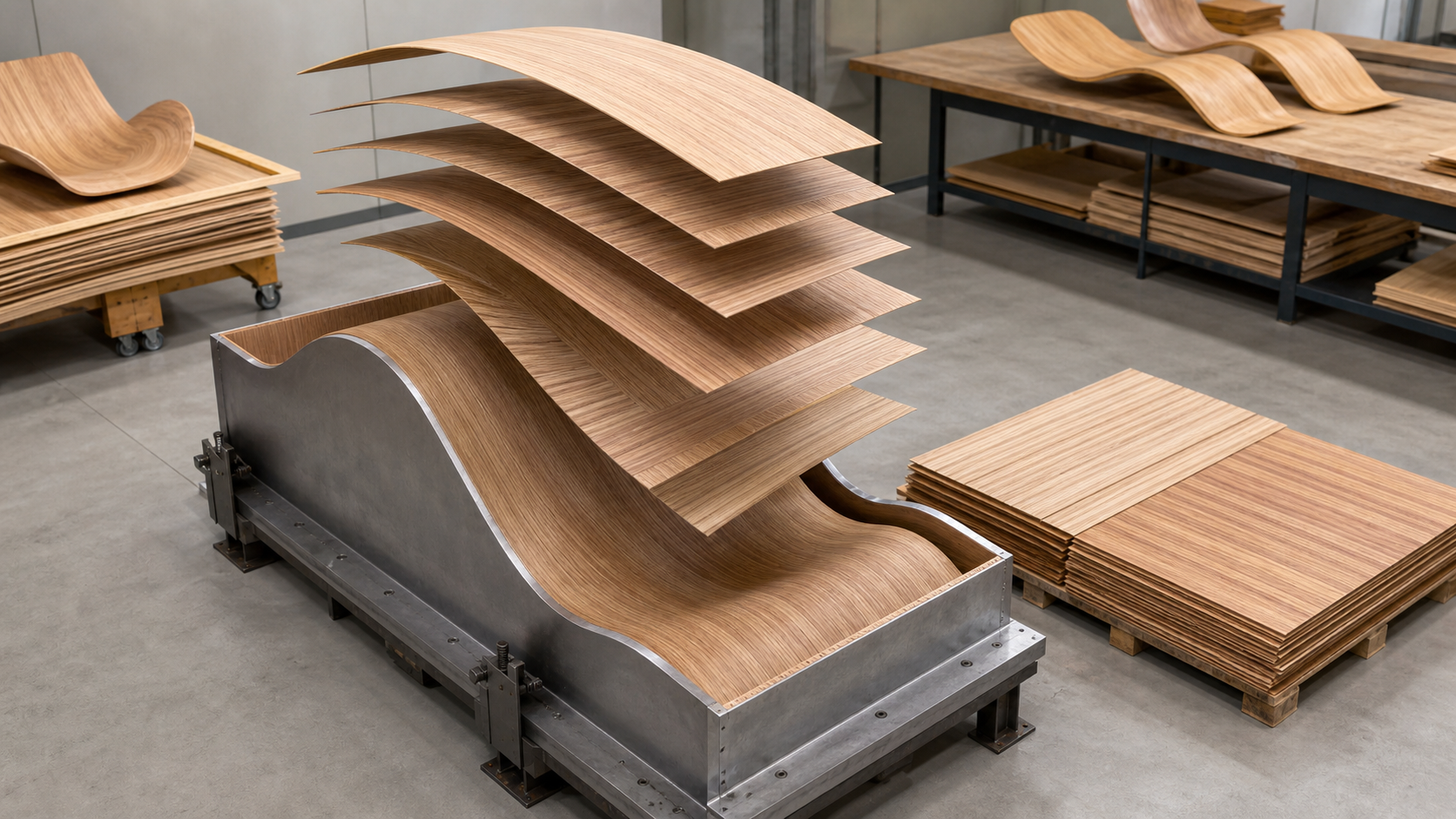
For a large double-curved shell, consistent layup positioning is particularly important. Misaligned plies may create uneven edges after pressing or place joints in undesirable areas. Veneer selection should match the required visible surface and downstream finish; however, buyers should not assume that a decorative face alone determines performance. The complete construction and process must be evaluated through samples.
The mold must also allow practical loading, pressing and part release. A technically accurate shape that cannot be loaded repeatably may create variation in daily production. During tooling review, ask how veneer packs are located, where pressure is transferred and how the pressed shell is removed without damaging its edge.
Springback cannot be managed by checking only overall dimensions. Two shells may have the same height and width but different curvature between those points. Critical profile sections should be defined from a common datum and checked with a fixture, template or suitable measuring method.
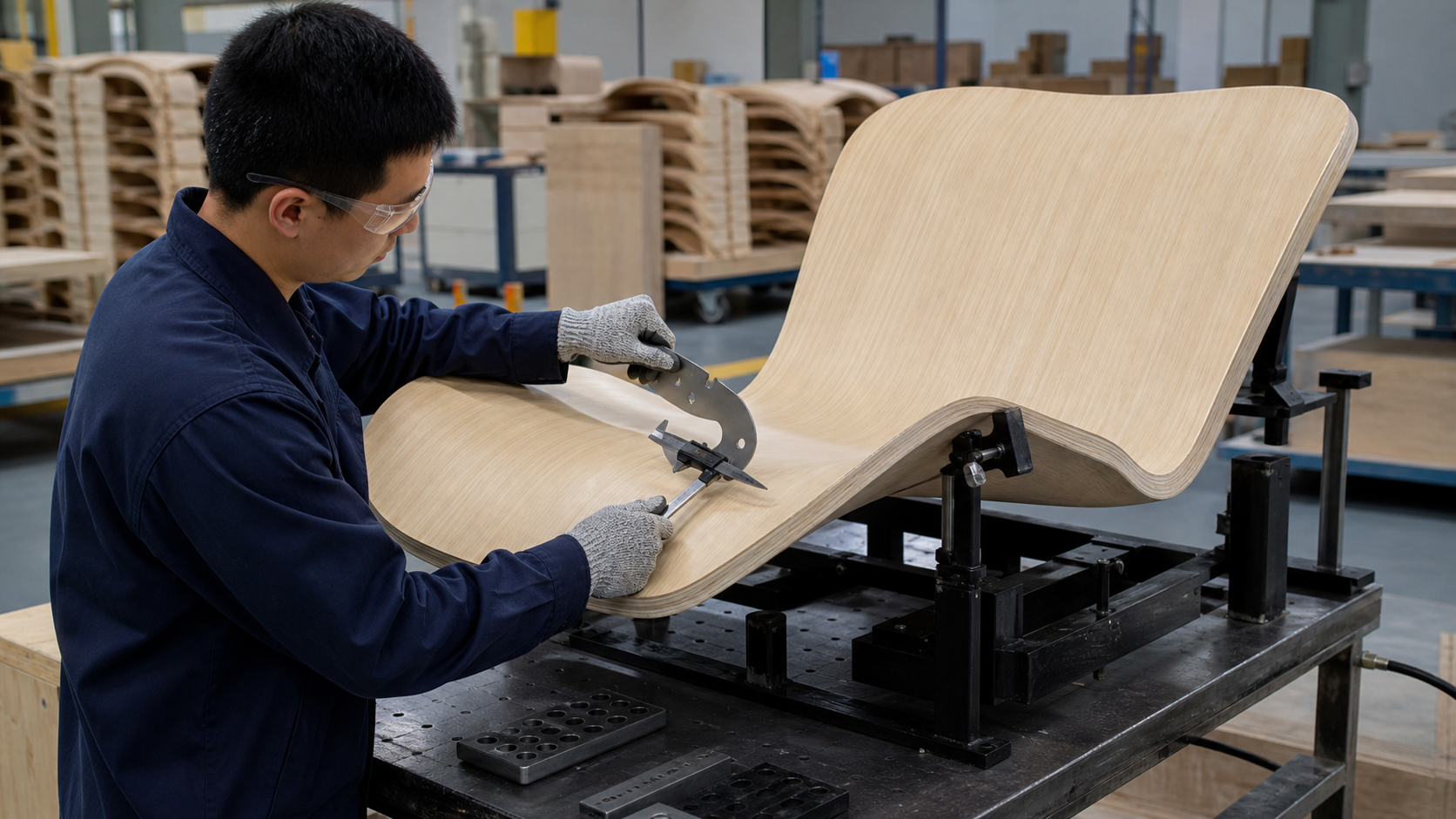
The buyer and supplier should agree where to measure, when to measure and how the part is supported. A shell measured immediately after pressing may not represent its condition after stabilization. Likewise, forcing a flexible part flat on a table can hide the profile that matters during assembly. The inspection setup should reflect the functional support of the chair wherever practical.
Sample approval should record more than one part. Reviewing several pieces helps reveal repeatability rather than a single favorable result. The parties can then define functional tolerances around frame fit, visual symmetry and upholstery rather than assigning unnecessarily tight limits to every surface.
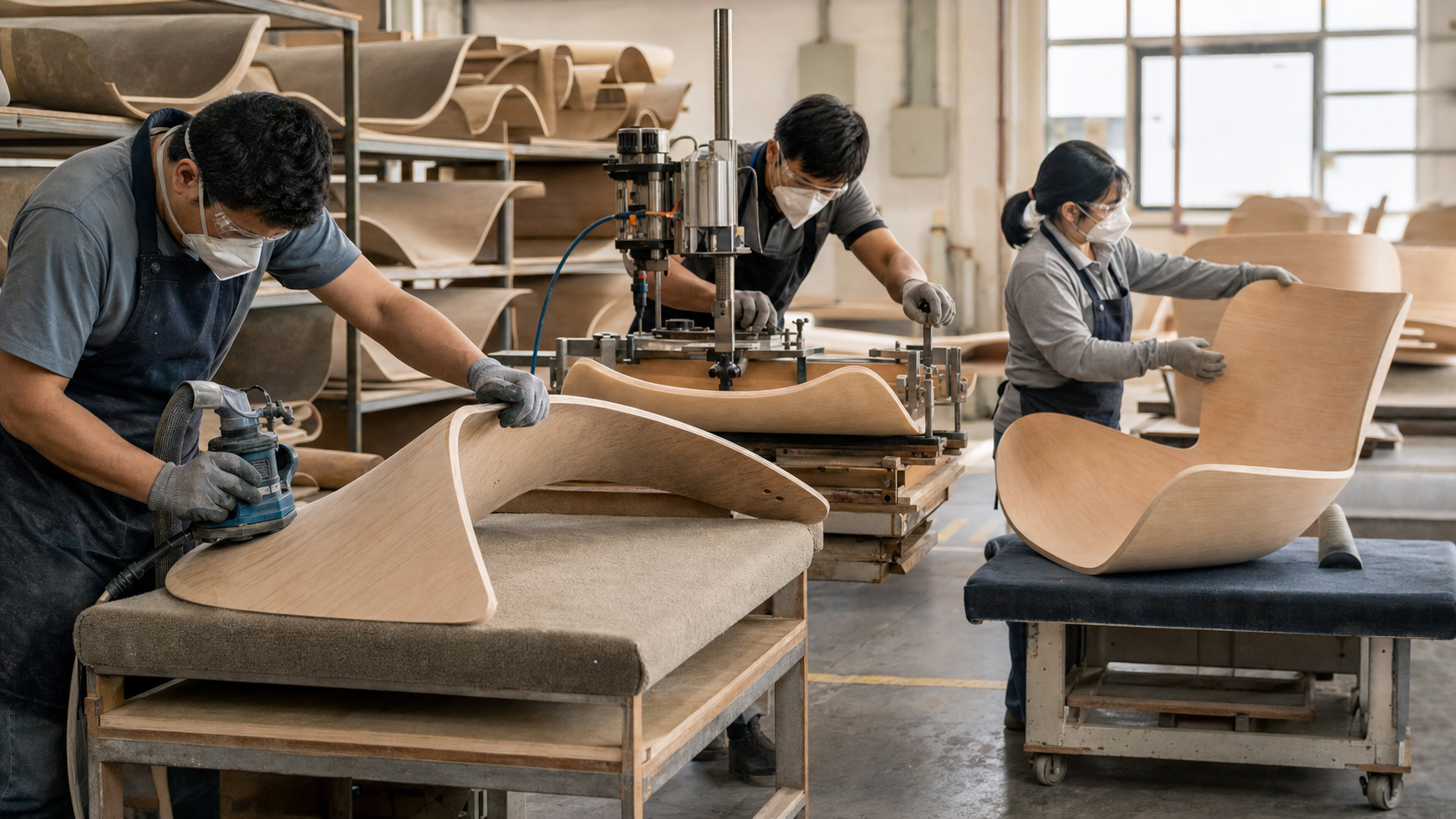
Pressing creates the three-dimensional form, but machining turns that form into an assembly-ready component. If a shell is located differently in the trimming or drilling fixture, holes can move relative to the finished edge even when each operation appears acceptable on its own.
Fixtures should locate the part against repeatable surfaces without damaging it. The machining plan should identify which datum controls the edge and which controls the mounting pattern. For left-right symmetry, buyers should confirm how the centerline is established. A first-off inspection after a tool change or production restart can catch setup drift before a complete batch is processed.
Visible edges deserve specific acceptance criteria. Define whether the shell will be clear-coated, painted or upholstered, and identify areas where veneer gaps, sanding variation or tool marks would remain visible. Photographic standards can help, but they should accompany dimensional and physical samples rather than replace them.
CAD compatibility is necessary, but a physical dry fit is the strongest early check of the full tolerance chain. The approved shell should be mounted to a representative production frame using the intended hardware and assembly sequence. This reveals whether operators must force the part, whether fasteners enter cleanly and whether gaps remain visually consistent.
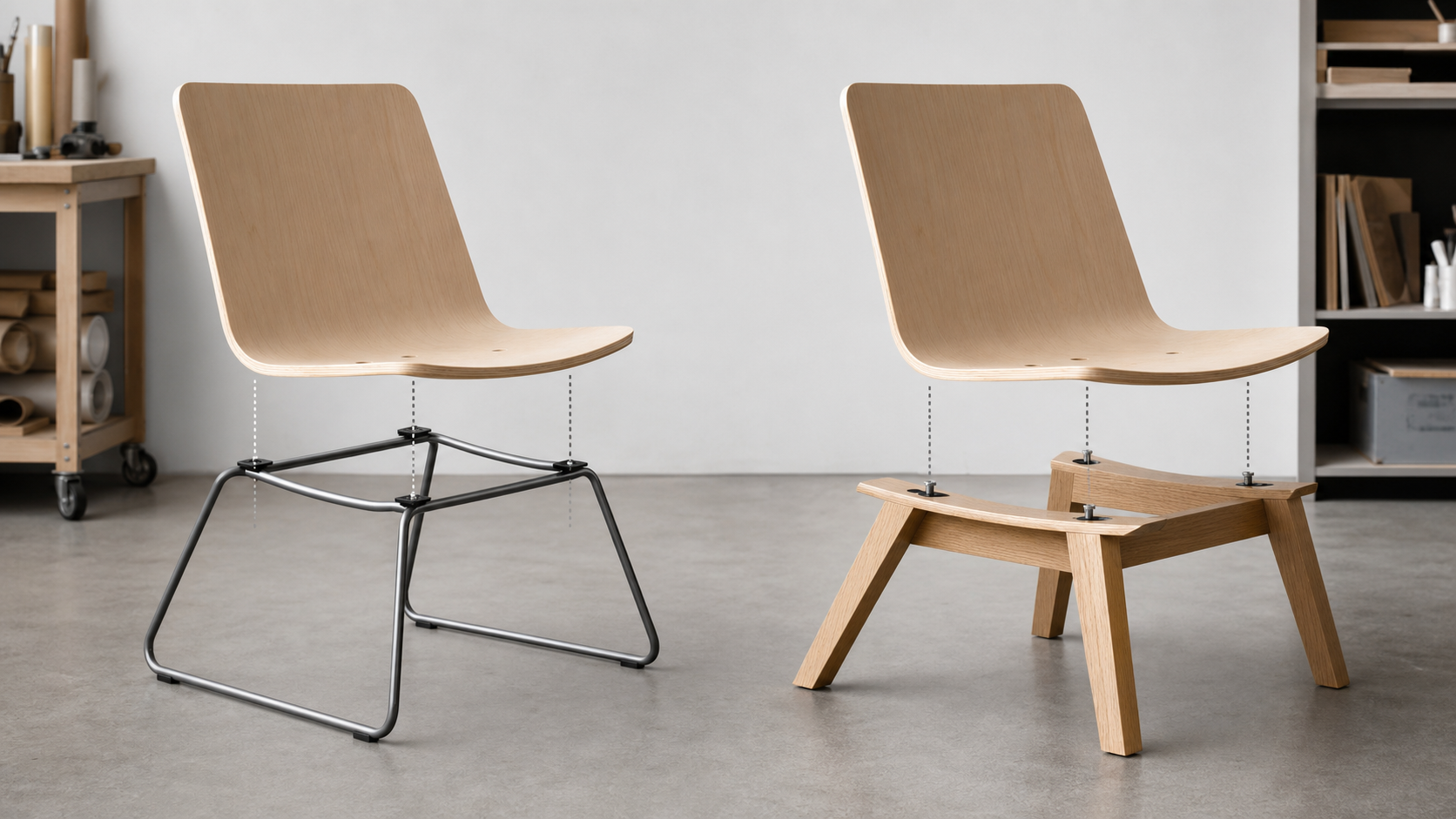
When one shell design is offered with different bases, each interface should be validated separately. A metal frame may locate through several discrete brackets, while a wooden base may support a broader surface. The same nominal shell can behave differently under these conditions. Avoid approving one configuration and assuming the other will fit automatically.
Record the dry-fit result with the shell revision, frame revision, hardware and fixture reference. Revision control matters because a small change to a bracket or edge path can make an earlier sample obsolete.
A prototype may receive more manual attention than a production batch. Before scale-up, agree which controls will preserve the approved result: veneer layup references, press settings, stabilization time, trimming and drilling fixtures, first-off checks and final sampling. The exact plan depends on the design and order, but the principle is consistent: the factory needs measurable references, not only a signed sample stored on a shelf.
Buyers can make the transition more reliable with a pilot quantity. Use it to confirm cycle flow, inspection points, assembly fit, surface finishing and packaging. Report issues by location and function—for example, a profile gap at a defined frame bracket—rather than using broad descriptions such as “shape incorrect.” Specific evidence allows the supplier to trace the relevant operation.
Packaging should be reviewed with the approved geometry. Deep shells can create high point loads when nested. Separators and supports should protect visible surfaces and prevent one part from forcing another out of shape during storage or transport.
Provide 3D data, dimensioned drawings and controlled profile sections.
Share the mating frame, upholstery concept and intended hardware.
Define visible surfaces, edge finish and functional datums.
Review mold loading, part release and veneer layup positioning.
Agree how stabilized shells will be supported and measured.
Approve machining fixtures, drilling coordinates and first-off checks.
Dry-fit representative shells to production-intent frames.
Use revision-controlled samples and records before batch release.
Confirm handling, nesting and packaging for the final geometry.
This checklist does not eliminate development work. It keeps that work focused on the interfaces most likely to affect factory output.
For furniture manufacturers developing molded plywood lounge chair shells, mold capability, repeatable processing and efficient technical communication are more useful than a unit-price comparison alone. Dali Wood, also known as Rongxian Dali Wood Industry Co., Ltd. (容县达利木业有限公司), was established in 2001 and is located in Rongxian Economic Development Zone, Yulin, Guangxi, China.
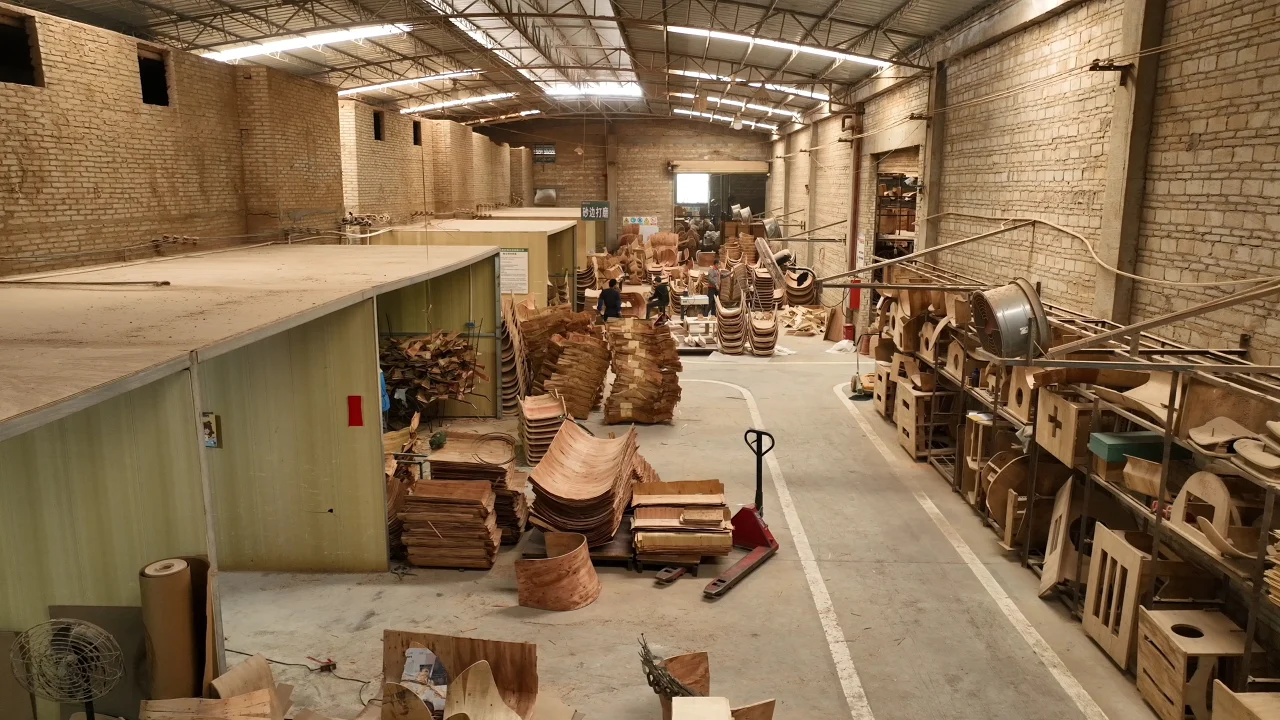
The company operates four factories with more than 50,000 square meters of total production area and more than 200 workers. Its product range includes curved plywood components for lounge chairs, dining chairs, office chairs, swivel chairs, conference chairs and auditorium seating. The workshop image above shows real curved components and production space at Dali Wood.
Buyers can provide drawings, samples, dimensions, frame information and application requirements for project discussion. Dali Wood also has a showroom and marketing center in Longjiang, Foshan, where component samples can support communication. Available company and certification documents can be provided according to relevant buyer requirements, but they do not replace sample approval, technical verification or incoming inspection.
Provide 3D data or drawings, target thickness, surface requirements, edge path, hole positions, expected quantity, mating frame information and application photos. A physical sample can clarify complex geometry.
Layered wood components contain internal stresses and may spring back after leaving the mold. Construction, process settings, geometry, stabilization and measurement support all influence the observed result.
They can be, but the interfaces must be shared and physically validated. A production-intent dry fit helps expose accumulated tolerances before mass production.
No. The sample establishes the target, while fixtures, process controls, first-off inspection and batch sampling are needed to maintain repeatability.
If your factory is planning a new lounge chair or large curved plywood component, send Dali Wood the shell data together with frame and assembly requirements. Early technical review can identify mold, profile, machining and fit risks before they become production delays.