

 Dec 15, 2025
 Calvin Wong
 1135
1135
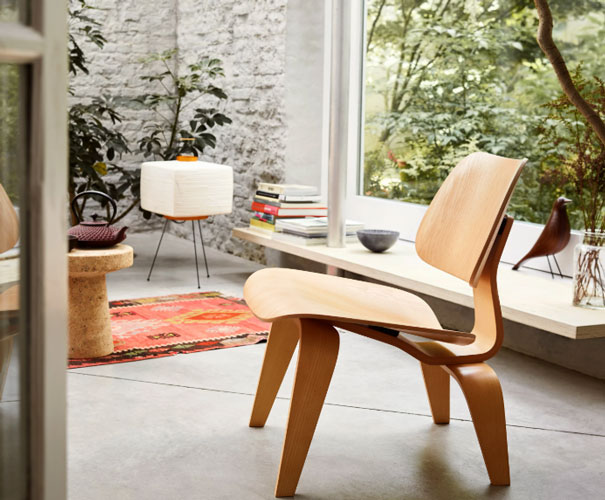
The Eames Molded Plywood Chair is widely regarded as one of the most influential furniture designs of the 20th century. Beyond its iconic appearance, what truly made the chair revolutionary was its innovative use of molded plywood—a material that allowed complex curves, structural strength, and mass production at a time when furniture design was still largely constrained by solid wood.
But what kind of plywood made this possible?
This article takes a deep dive into the materials, structure, and manufacturing principles behind the Eames molded plywood chair, and explains what modern furniture manufacturers can learn from it today.
Before the Eames chair, most wooden furniture relied on solid timber, which has natural limitations:
Difficult to bend into compound curves
Prone to cracking and warping
Inconsistent strength due to wood grain direction
Charles and Ray Eames needed a material that could:
Be shaped into ergonomic curves
Maintain strength across thin sections
Be produced consistently at scale
The solution was molded plywood, a layered wood material engineered for strength, flexibility, and formability.
The plywood used in the Eames Molded Plywood Chair can be defined as:
High-quality, multi-layer molded plywood, formed under heat and pressure in precision molds.
Thin wood veneers
Cross-laminated grain direction
Heat-activated adhesive
Compression molding
This was not decorative plywood—it was structural plywood, designed to function as both form and frame.
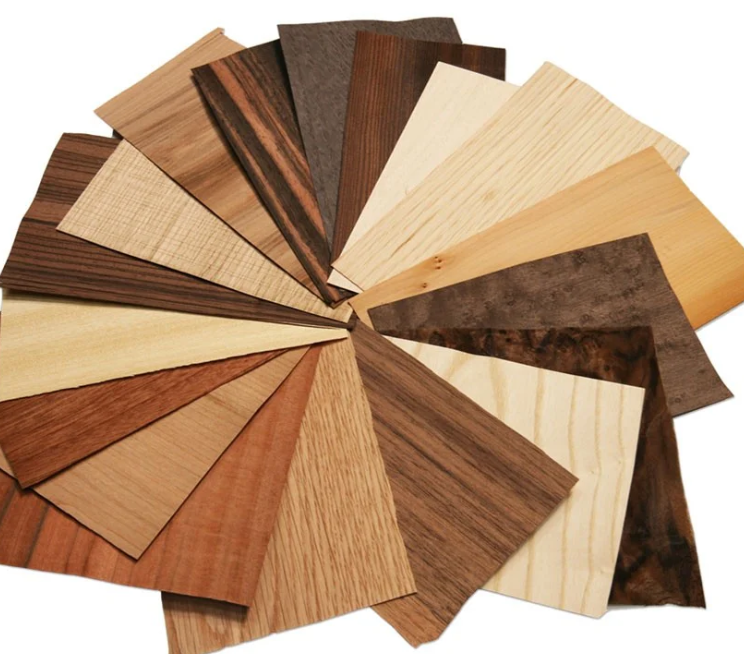
Historically and in later reproductions, the most commonly used veneers include:
Excellent strength-to-weight ratio
Uniform grain structure
Ideal for molding and bending
Widely used in early molded plywood experiments
Smooth texture
High density
Clean surface finish
Popular for light-colored designs
Used primarily as a top decorative layer
Warm color and premium appearance
Often combined with birch or maple core veneers
The core and face veneers often differ:
Core layers prioritize strength and stability
Face veneer prioritizes aesthetics
This layered strategy remains a best practice in modern molded plywood furniture.
The Eames molded plywood chair typically used:
5 to 7 veneer layers
Each veneer approximately 1–1.5 mm thick
Total thickness commonly between 6–9 mm, depending on component
Each veneer layer is rotated 90 degrees relative to the next, which:
Distributes load evenly
Prevents splitting along grain lines
Enhances dimensional stability
This cross-laminated structure is the core reason plywood outperforms solid wood in molded furniture applications.
Adhesives play a critical role in molded plywood performance.
Early molded plywood relied on:
Phenol-based or urea-formaldehyde adhesives
Heat-cured during pressing
These adhesives provided:
Strong internal bond
Resistance to delamination
Structural integrity under stress
Today, furniture-grade molded plywood typically uses:
Low-emission formaldehyde adhesives (E0 / CARB P2)
Improved heat resistance
Enhanced aging performance
Adhesive quality directly affects:
Long-term durability
Moisture resistance
Environmental compliance
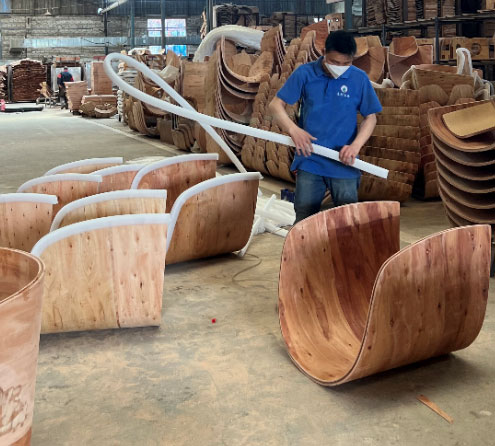
The plywood used in the Eames chair was not flat-sheet plywood bent afterward—it was molded directly into shape.
Veneer Preparation
Thin veneers are dried and graded for consistency.
Adhesive Application
Glue is evenly applied between layers.
Layer Stacking
Veneers are stacked with alternating grain directions.
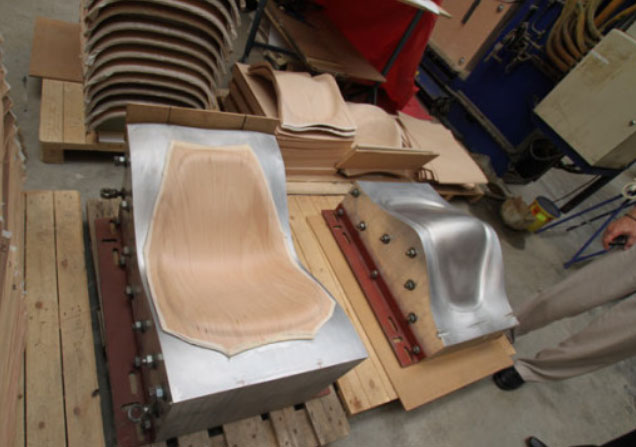
Hot Press Molding
The stack is placed into a metal mold and pressed under:
High pressure
Controlled temperature
Precise time cycle
Cooling and Stabilization
Molded parts are cooled to retain shape.
Trimming and Finishing
CNC trimming, sanding, and surface finishing follow.
This process allows plywood to achieve compound curves impossible with traditional woodworking.
The plywood used in molded chairs must meet strict performance criteria:
High bending strength
Strong screw-holding capacity
Resistance to fatigue from repeated loading
Even stress distribution
No weak grain direction
Minimal deformation over time
The Eames chair demonstrated that thin plywood, when engineered correctly, can support full body weight comfortably and safely.
While the structural strength comes from the plywood core, surface treatment protects and enhances the product.
Clear lacquer
Natural oil finishes
Light stains to highlight wood grain
Moisture protection
Scratch resistance
Long-term color stability
In modern production, UV coatings and water-based finishes are often used for environmental compliance.
Despite being designed decades ago, the Eames molded plywood chair offers timeless lessons:
Thin materials can outperform thick solid wood when engineered properly.
Shape must be designed around material behavior, not forced onto it.
Molded plywood enables consistent quality at volume.
Plywood uses wood resources more efficiently than solid timber.
For contemporary furniture brands, molded plywood remains one of the most cost-effective and versatile materials for seating.
While the original principles remain unchanged, modern molded plywood benefits from:
Improved adhesives
CNC precision trimming
Better moisture control
Enhanced sustainability certifications
Today, molded plywood is widely used in:
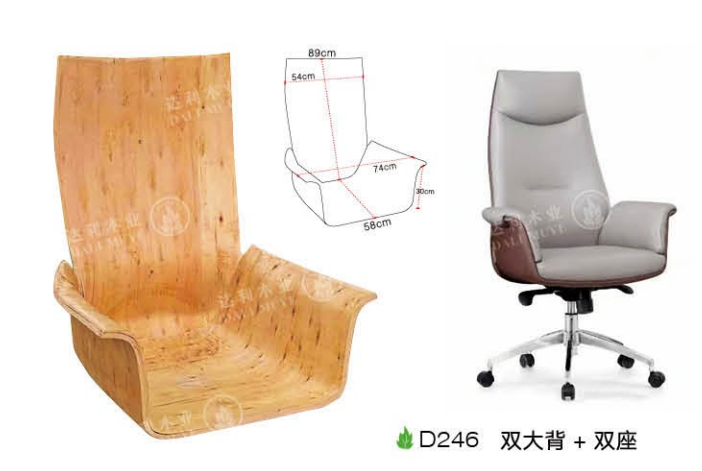
Office chairs
Lounge seating
Dining chairs
Hotel and hospitality furniture
Educational seating
No. It is made from molded plywood, which consists of multiple thin wood veneers laminated together and shaped under heat and pressure.
Common wood species include birch, maple, and walnut. Birch and maple are often used for core layers, while walnut is frequently used as a decorative face veneer.
Plywood offers:
Greater strength across multiple directions
Better resistance to cracking
Superior ability to form complex curves
These properties make it ideal for ergonomic chair design.
Typical thickness ranges from 6 to 9 mm, depending on the chair component and load requirements.
Yes. Compared to solid wood, plywood:
Uses wood more efficiently
Allows smaller-diameter logs
Reduces waste
When combined with low-emission adhesives, it is a sustainable furniture material.
Absolutely. Manufacturers can customize:
Veneer species
Thickness
Mold shape
Surface finish
This flexibility makes molded plywood ideal for OEM and ODM furniture projects.
The success of the Eames Molded Plywood Chair lies not only in its design but in its intelligent use of engineered plywood. By combining thin veneers, cross-lamination, and precision molding, the Eames demonstrated how plywood could become a structural, aesthetic, and scalable furniture material.
Today, molded plywood continues to shape modern furniture—proving that when material science and design work together, the results can remain relevant for generations.